

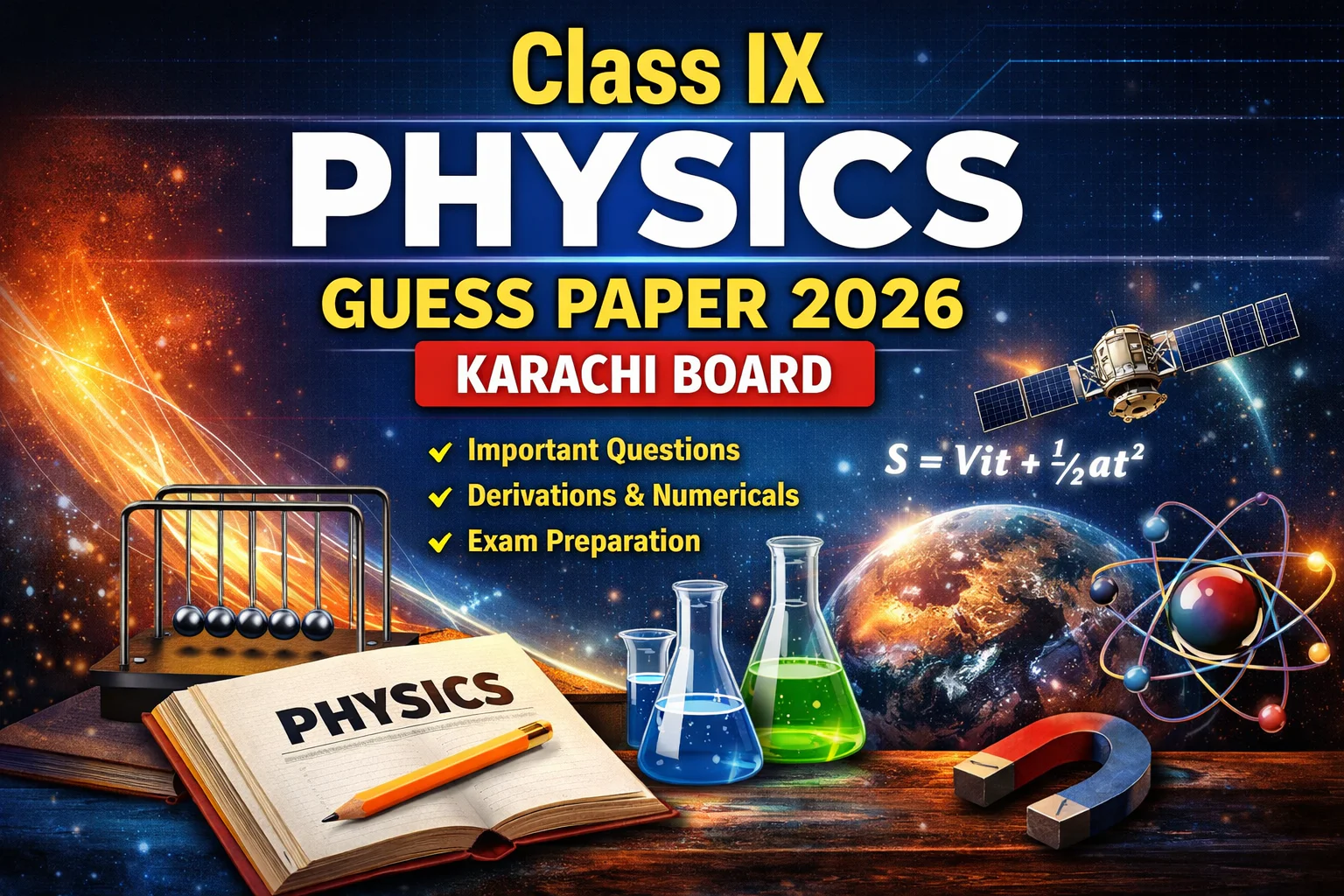
Chapter 1: Physical Quantities and Measurement
- Define Physics. Name and define branches of Physics.
- Define fundamental and derived physical quantities with examples.
- What is density? Give its formula and unit.
Chapter 2: Kinematics
- Define types of motion with examples.
- What are the three types of translatory motion?
- Differentiate between distance & displacement, speed & velocity, scalar & vector.
- What is acceleration? Give formula and unit.
- Derive second equation of motion: S = Vit + ½at²
- Derive third equation of motion: 2as = Vf² – Vi²
Chapter 3: Dynamics
- Define momentum with formula and SI unit.
- State and explain Law of Conservation of Momentum.
- Prove F = Δp/t
- What is inertia? State Newton’s 1st and 3rd laws.
- State Newton’s 2nd law and show F = ma.
- Differentiate between mass & weight, centripetal & centrifugal force.
- What is friction? Advantages and disadvantages.
- Ways to reduce friction.
Chapter 4: Turning Effect of Forces
- Define resolution of vector and derive rectangular components.
- Define resultant of vectors and direction.
- Define torque with formula and unit.
- State condition of equilibrium.
- States of equilibrium.
- Types of equilibrium with examples.
Chapter 5: Forces and Matter
- Define pressure with SI unit and formula.
- Two factors affecting pressure.
- State and explain Hooke’s Law.
- State Pascal’s Law.
- Hydraulic machine and working of hydraulic press.
Chapter 6: Gravitation
- State and explain Newton’s law of gravitation.
- Characteristics of gravitational force.
- Differentiate between G & g, natural & artificial satellite.
- Derive mass of Earth using gravitational formula.
- Derive V² = GM/(R + h)
Chapter 7: Properties of Matter
- Discuss kinetic theory of gases.
- What is Brownian motion? State Boyle’s Law.
Chapter 8: Energy Sources and Transfer of Energy
- Define work with formula and unit.
- Define energy. Differentiate kinetic and potential energy.
- State law of conservation of energy.
- Differentiate renewable and non-renewable energy.
- Define wind energy with applications.
- Define power with formula and unit.
- Derive P.E = mgh
- Derive K.E = ½mv²
Chapter 9: Thermal Properties of Matter
- Differentiate heat and temperature.
- Differentiate boiling point and evaporation.
- Define evaporation and factors affecting it.
- Define thermal expansion and linear expansion.
- Define volumetric expansion.
- Short note on bimetallic thermostat and rivets.
Important Numericals
- Convert radius of hydrogen atom into km, mm, micrometer.
- Distance covered by train (36 km/h in 3 hours).
- Acceleration of car from rest.
- Final velocity of bus.
- Velocity before hitting ground.
- Maximum height of vertically thrown body.
- Recoil of gun.
- Acceleration using F = ma.
- Speed in circular motion.
- Momentum calculation.
- Force and acceleration problem.
- Weight on Earth, Moon and Mars.
- Centripetal force and acceleration.
- Horizontal and vertical components of force.
- Resultant force.
- Torque calculation.
- Spring extension using Hooke’s Law.
- Pressure in water.
- Pressure using force and area.
- Pressure under sea.
- Hydraulic lift calculation.
- Hydraulic press problem.
- Gravitational force between masses.
- Mass from weight.
- Gravity on another planet.
- Satellite speed.
- Boyle’s law problem.
- Work done calculation.
- Kinetic energy problems.
- Potential energy calculation.
- Power calculation.
- Efficiency calculation.
- Temperature conversions.
- Specific heat capacity.
- Heat required.
- Heat capacity.
- Linear expansion.
What do you feel about this post?
0%

Like
0%

Love
0%

Happy
0%

Haha
0%

Sad
0%